
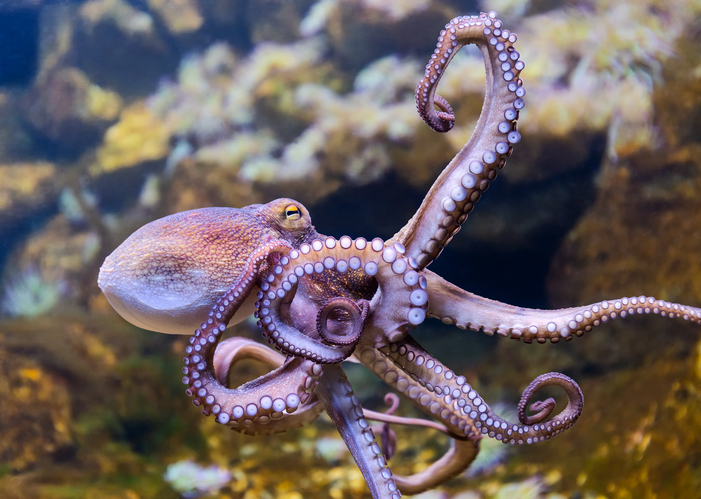
Introducing the common octopus
Octopus are some of the most fascinating and incredible creatures on the planet. They have a distinctive appearance and are considered the most intelligent of all invertebrates. So, let’s learn more about the common octopus (Octopus vulgaris).
The common octopus is a cephalopod, making it related to squid, cuttlefish and nautilus. Cephalopods are typically characterised by soft bodies and a merged head and foot, with arms or tentacles.
They can span from 30cm up to 90cm in size, and can weigh up to 10kg.
Native habitat and range
The common octopus is usually found in tropical and temperate waters, including the Atlantic Ocean and the Mediterranean Sea. You will even find them off the southern coast of the UK!
They are known as a benthic species which means they prefer the floor of shallow, rocky and coastal waters. Common octopus will create dens using rock crevices, holes, coral rubble and shells, keeping themselves safe.
Fascinating anatomy of a common octopus
The common octopus has a soft, boneless body that’s divided into a large, round mantle, its head and then 8 flexible arms. They have what’s known as a hydroskeleton instead of bones, which is a fluid-filled muscle system.
What’s even more interesting though, isn’t it multiple limbs, but its multiple brains and other organs! Octopus have a total of 9 brains, with a central brain and a singular brain at the base of each arm. This allows the octopus to move each arm independently.
Common octopus also have 3 hearts, with two being responsible for blood flow to the gills for breathing underwater. The third heart helps to circulate oxygenated blood around the body.
You might not see it very often, but the common octopus has a beak rather than a mouth. The tip of the beak is hard but it gets more flexible as you reach the base. This is so it doesn’t hurt the octopus where it meets its body.
Amazing adaptations and defence
The common octopus has a number of fascinating skills to help it survive. Firstly, they have special pigment cells called chromatophores along with skin bumps called papillae that help them to change colour, pattern and texture. This can help it to evade predators like sharks and dolphins.
Common octopus can also release a cloud of black ink when they have been discovered, which gives it time to escape. As well as this, the common octopus is a fast swimmer, expelling water through their mantles to jet forward.
Thanks to their soft bodies, common octopus are able to squeeze into incredibly small crevices and cracks where predators can’t get to them. If these defense mechanisms don’t work, the octopus can lose its arm to escape a predator’s grip and simply regrow it later!
Common octopus lifespan
Surprisingly, the common octopus only has a relatively short life of 1-2 years. This is because the octopus grows incredibly quickly, going from a small larva to a large adult in this time. They also reach reproductive maturity at around 1-1.5 years old, coming to the end of their life shortly after this.
The common octopus also goes through a process called senescence. Once they have reproduced and contributed to the next generation of octopus, senescence occurs at the end of a mature octopus lifespan and is the natural last stage of their life cycle.
Common octopus conservation status
Currently the common octopus is classified as Least Concern by the IUCN Red List, but it’s important to remember that threats like overfishing, bycatch and climate change can all contribute to changes in their population.
Find me in Weird and Wonderful!
Here at Tynemouth Aquarium you can see the common octopus and a whole host of other fascinating creatures in our Weird and Wonderful exhibit! Come face to face with the European lobster (Homarus gammarus) or the big bellied seahorse (Hippocampus abdominalis). If you’re lucky you might also spot our chocolate chip starfish (Protoreaster nodosus) or the zebra dartfish (Ptereleotris zebra).
Whoever you’re hoping to see on your next visit to Tynemouth Aquarium, don’t forget to book your tickets!
Type
Cephalopod
What do they eat?
Crustaceans and small fish
Size
Up to 90cm
Water Type
Saltwater
Where are we?
Atlantic Ocean and Mediterranean Sea