
Isn’t it amazing that some marine animals are capable of glowing in the dark? Even in the murkiest depths of the world’s oceans, creatures can produce their own light – either to ward off predators, entice their prey, or to signal that they’re ready to mate.
But how exactly do animals glow in the dark? What’s the science behind it? And which species put on the most impressive light show? Join us and find out.
Can all animals glow in the dark?
While it would be pretty cool if all marine animals could glow in the dark, only a handful of species can. That includes the lanternfish, the vampire squid, deep-sea shrimp, and many species of jellyfish.
Of course, having the ability to glow in the dark isn’t simply a party trick. Animals rely on their underwater glow for a few reasons, including:
- Defence: Small, glowing fish species use light to startle or distract predators, giving them a narrow window in which to make a hasty getaway.
- Hunting: In some cases, a glow works in reverse, drawing prey in. It can also help illuminate nearby targets – crucial in the murky depths of our deepest oceans.
- Camouflage: Lots of fish use their natural glow as camouflage. They’re able to adapt their colouring to faint light from above, making them harder to spot by predator or prey.
- Communication: Some fish use their ability to glow as a signal to attract a mate.
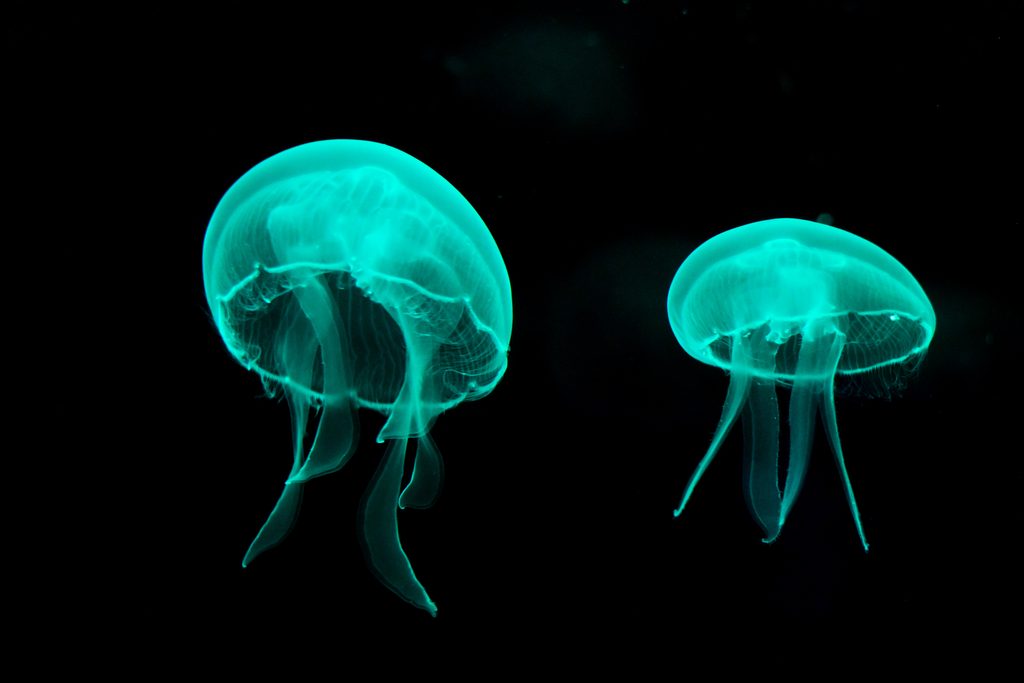
How do animals glow?
There are two natural processes behind this impressive ability: bioluminescence and biofluorescence. Let’s take a look at how these processes work and what’s behind them.
Bioluminescence
Bioluminescence happens due to a chemical reaction. When a light-producing chemical called luciferin meets oxygen, the reaction releases energy in the form of light. However, it can occur differently depending on the species.
For example, while some species produce their own bioluminescence, others host bacteria which take care of the process on their behalf.
Typically, bioluminescence happens in the mesopelagic zone, approximately 200–1,000 metres below the surface. This is where there is a reduction in natural sunlight, and animals have evolved to produce their own glow as a natural advantage in the fight for survival.
While it’s impossible to put an exact figure on the number of species capable of bioluminescence, scientists estimate that over 75% of all deep-sea creatures may be able to glow in the dark through this reaction.
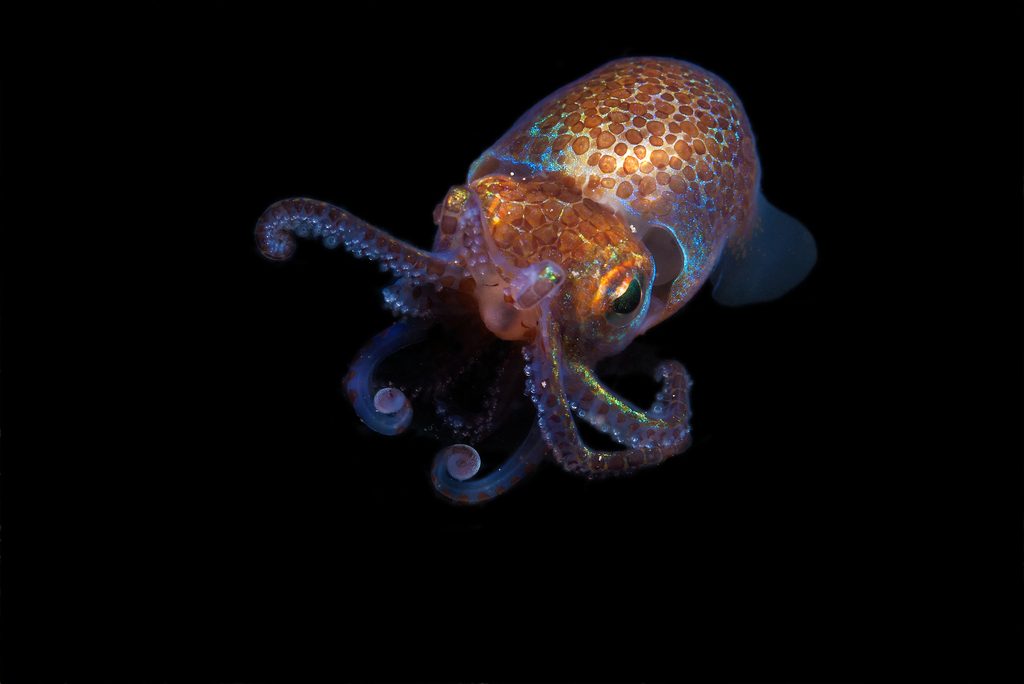
Of the species that produce their own glow, this includes the firefly squid, the Atolla jellyfish, and the stoplight loosejaw. Meanwhile, species that host bacteria to benefit from bioluminescence include deep-sea anglerfish, the Hawaiian bobtail squid, and the flashlight fish.
Biofluorescence
Biofluorescence is a natural phenomenon in which an animal absorbs light at one wavelength and re-emits it at another. This causes a vivid glowing effect, usually in bright colours like green, orange, red and yellow.
The process of biofluorescence has three stages, including:
- Light absorption: An animal absorbs blue or ultraviolet light.
- Energy conversion: Fluorescent molecules in the animal’s tissue absorb this light as energy.
- Light emission: The molecules release light at a different energy wavelength, creating a bright spectrum of colour.
Since biofluorescence relies on external light, it occurs at much shallower depths than bioluminescence. For instance, it’s not uncommon in tropical, sunlit waters up to a depth of around 200 metres, and is also known to occur in the mesophotic zone, approximately 30–150 metres below the surface.
A huge variety of marine animals display biofluorescence, including species from across 87 families and 34 orders. First up, the beautiful sea turtle. Scientists have observed biofluorescence in several species, most prominently the hawksbill turtle, with bright colours emitting from their shells and skin.
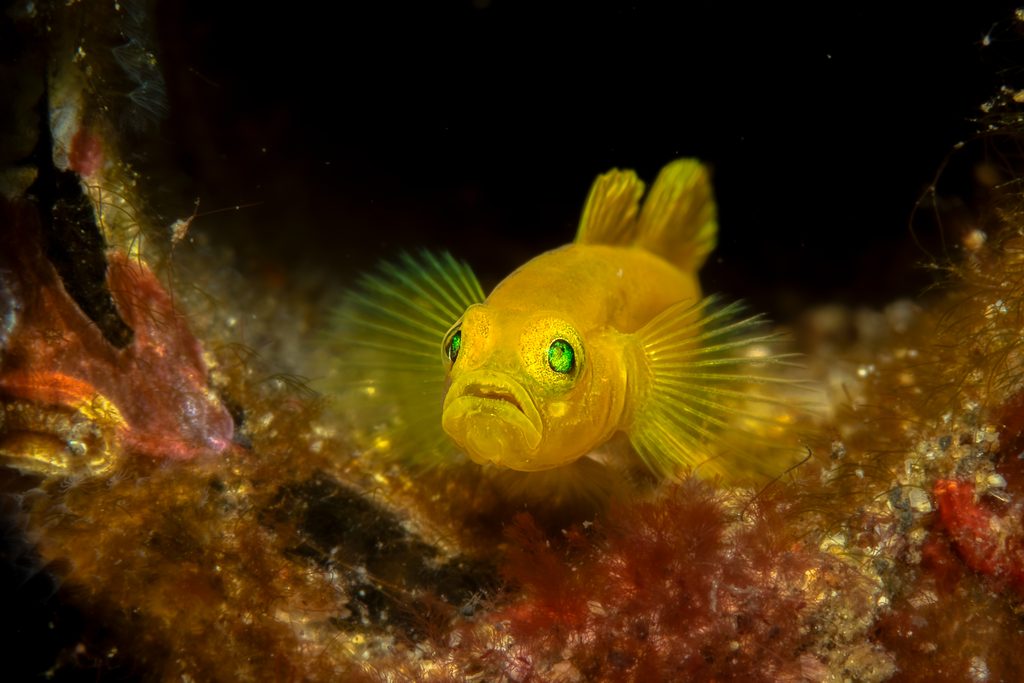
There are, of course, many species of fish and sharks which display biofluorescence too, including catsharks, swell sharks, and many species of coral-dwelling fish. Pygmy gobies, fairy wrasses, and reef pipefish are some of the small fish capable of biofluorescence, chiefly using it for camouflage and for attracting a mate.
Biofluorescence vs bioluminescence summary
Thousands of species rely on biofluorescence and bioluminescence to glow in the dark. But it’s important to remember that these are different processes, occurring at different depths and for lots of different reasons.
| Feature | Biofluorescence | Bioluminescence |
| How it occurs | External light, such as sunlight or blue light | Chemical energy |
| Requires external light? | Yes | No |
| Visible in complete darkness? | No, not without an external light source | Yes |
| Typical colours | Green, red, orange and yellow | Commonly blue or green in marine environments. Other colours also occur |
| How it works | Fluorescent molecules absorb light energy and re-emit it at a different wavelength | Light-producing chemicals like luciferin and oxygen react |
| Where it occurs | Usually in shallow coral reefs and sunlit marine habitats | Widespread in the ocean, especially in deep-sea environments |
Meet the weird and the wonderful at Tynemouth Aquarium
From the incredible flashlight fish to the blue-spotted ray – some of the animals right here at Tynemouth Aquarium are capable of glowing in the dark. Our exhibits are designed to mimic the natural habitats of all the amazing creatures that we’re fortunate enough to house, so you can look forward to an authentic up-close experience.
Learn more and book your visit to Tynemouth Aquarium today.